

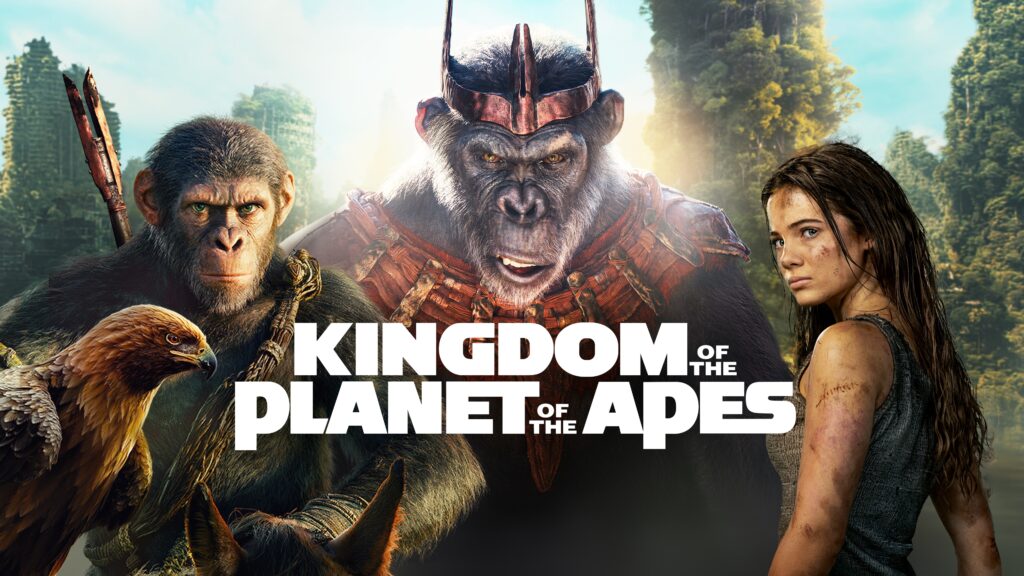
Generations have passed since Caesar, the legendary leader of the apes, led his kind to a new home. The world has drastically changed. Humanity has fallen into tribal, feral states, and apes have now risen to dominate much of the planet.
Different ape clans interpret Caesar’s legacy in very different ways—some honor his peaceful ideals, while others twist his memory to justify tyranny and conquest.
Noa lives peacefully in a forest village with his tribe, until one day, it is attacked and destroyed by soldiers loyal to Proximus Caesar, a powerful bonobo warlord. Noa’s father is killed, and his people are taken.
Determined to rescue them, Noa leaves on a journey. Along the way, he meets Raka, a gentle orangutan who educates Noa about the original Caesar’s philosophy: compassion, freedom, and unity.
They also encounter Mae, a mysterious human who can speak and read—something unheard of in this age. Mae holds secrets that could change everything.
The trio eventually arrives at the fortified kingdom ruled by Proximus Caesar, a brutal leader who believes apes must conquer all and that humans are dangerous relics of the past. He uses ancient human knowledge—tech and weapons—to expand his power.
Proximus is searching for a vault containing advanced human technology, which he believes will make him a god among apes.
Mae, however, knows the truth about the vault and fears its destructive potential.
Noa grows into a true leader, understanding that Caesar’s real strength was not power, but wisdom and compassion. With the help of loyal apes and humans, he leads a rebellion against Proximus.
A fierce battle erupts. Proximus opens the vault, hoping to unlock human weapons—but Mae sabotages it, preventing disaster.
In a final confrontation, Noa defeats Proximus but refuses to kill him, showing mercy in Caesar’s name.
Noa frees his people and begins rebuilding his tribe. He and Mae agree to build a future where apes and humans might coexist, even if it will take generations.
The legacy of Caesar lives on—not through war, but through those who understand what he truly stood for.

Christopher Reeve was the beloved actor best known for playing Superman in the iconic 1978 movie and its sequels. But his most powerful legacy came off-screen—after a life-altering accident that turned him into a real-life symbol of courage, resilience, and hope.
The film begins by exploring Reeve’s early life:
- Born in 1952 in New York.
- Passion for acting and the stage.
- Breakout role as Superman (1978), where he portrayed both Clark Kent and the Man of Steel with warmth, charm, and idealism.
Through behind-the-scenes footage and interviews with friends, family, and cast members, we see Reeve’s rapid rise to fame, his commitment to the craft, and his desire not to be typecast.
In 1995, Reeve suffered a devastating spinal cord injury in a horseback riding accident that left him paralyzed from the neck down and dependent on a ventilator.
The film doesn’t shy away from the darkness he faced: depression, despair, and thoughts of giving up. But it’s here that the true depth of his heroism begins.
His bond with his wife Dana Reeve, who stood by him through everything, is a central emotional pillar of the story.
The film uses home videos, interviews, and Reeve’s own voice to showcase his determination, wit, and emotional strength—even when trapped in a body that couldn’t move.
Though Reeve passed away in 2004, the film leaves viewers with the incredible impact of his legacy. From millions raised for medical research to his influence on disability representation in media, Reeve truly lived up to the values of the character he portrayed.
It’s a moving tribute to a man who redefined heroism not through physical strength, but through inner courage.